Monday, 15 August 2011

The Heisei boom, financial trickery, and central bank voodoo – Can the U.S. support two lost decades? Japan asset bubble collapse solutions exported to the United States. 9 graphs showing troubling similarities.

http://www.doctorhousingbubble.com/heisei-boom-financial-trickery-central-bank-voodoo-debt-federal-reserve-central-banks-too-big-to-fail-japan-us-bubbles/

The comparisons between the current real estate and debt debacles in Japan and the United States are hard to ignore. Not all horror stories of economic collapse follow the same script but it is hard to deny that we have incredible similarities and more mainstream articles are picking up on this trend. Take for example the current debt ceiling charade. It is amazing that we raised the debt ceiling with no subsequent changes to revenues and yet interest rates fell. Think about this on a more individual level. This is like a household who is spending beyond its means and suddenly raises its spending without any subsequent growth to income. Yet the fear spreading around the financial world still finds safety in the United States. At this point, it is better to store your money in the U.S. instead of Greece, England, Ireland, or Spain for example and the markets reflect this reality. Yet The U.S. is following a remarkably similar path to Japan’s lost two decades. As we approach our first lost decade it is important to examine what is happening on multiple fronts.

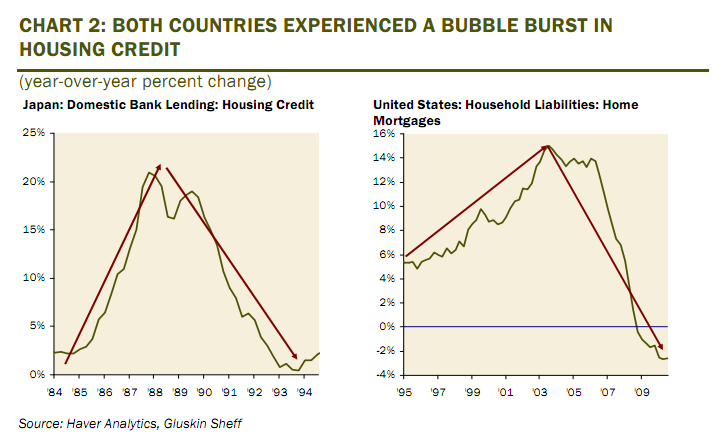
Japan and U.S. experience bubbles in home lending
Japan-US-Credit-Bubbles
Source: Gluskin Sheff
The U.S. and Japan both experienced unparalleled growth in bank lending to households to purchase real estate. In Japan this started in 1984 and collapsed in the early 1990s. In the U.S. the trend started in 1995 and collapsed in 2007. The collapse in the U.S. was actually more vicious once it hit. The only reason home prices have not contracted as severely in many areas is the emergence of shadow inventory on bank balance sheets. Japan had zombie banks and we have banks with shadow inventory but the comparison to the walking dead is very apt here. Both countries have insolvent banking systems and only through financial trickery and central bank voodoo can both systems pretend to be working. Yet both extract a toll on the productive sectors of the economy.
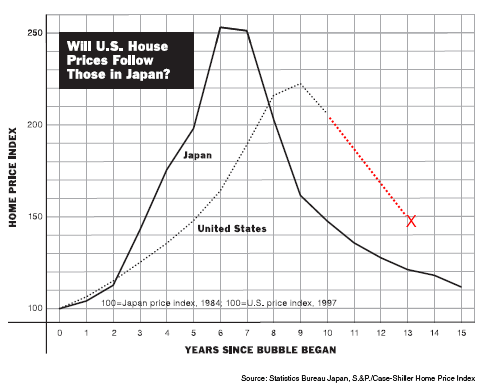
Real estate prices collapse in both countries
us vs japan home prices
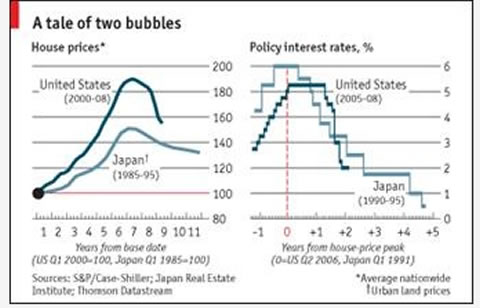
The collapse in housing prices has been similar in both countries and the path of each bubble seems extremely similar. For example, the above chart looks at Japan real estate starting in 1984 and aligns U.S. home prices starting in 1997. So a decade sets both bubbles apart but the path is unmistakable. Japan gave up all gains in their housing bubble bust and the U.S. housing market has yet to reach that trough. Does this mean a baseline of 1997 is where a true bottom will be reached? Hard to say yet there is little evidence to show for a rise in home prices. There is still over 6,000,000 homes in the shadow inventory that need to be liquidated at some point and will add pressure to home prices on the downside. In terms of bank housing lending collapsing and real estate values imploding we are two for two between Japan and the United States.
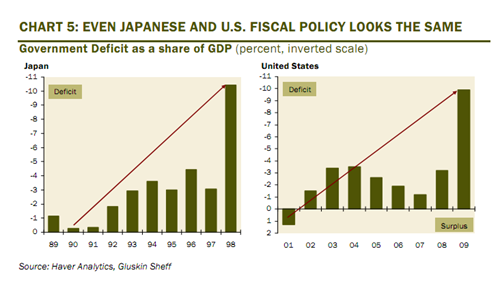
Japan and U.S. fiscal policy looks similar
Japan-US-Fiscal-Policy_thumb
Source: Gluskin Sheff
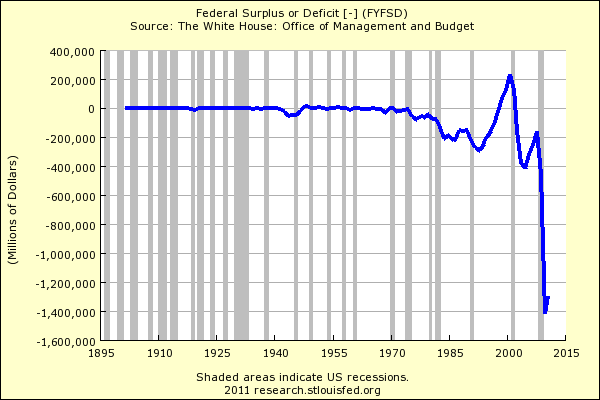
When bubbles burst a wide gap is left in the economy. Both the Bank of Japan and Federal Reserve stepped in and aided the banking systems of both countries but how well did this translate to helping the productive side of the economy? If the ultimate goal is to save the too big to fail banks then both central banks succeeded yet at what costs? Japan has now witnessed two lost decades while the U.S. is entering its first. Take a look at the above data. During the good years Japan was running a deficit of 1 to 3 percent. All of a sudden it was running deficits of 10 percent. The U.S. is running similar deficits and there is little evidence of a reversal here:
us deficit
With GDP at roughly $14 trillion we are running a deficit of over 10 percent. So far the similarities between Japan’s lost decades and the United States seem to be following a very similar path.
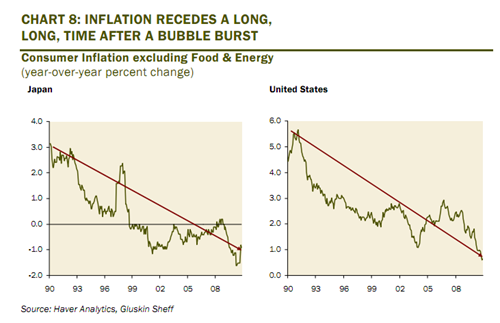
Pushing inflation lower at least as measured by government
Japan-US-Inflation_thumb

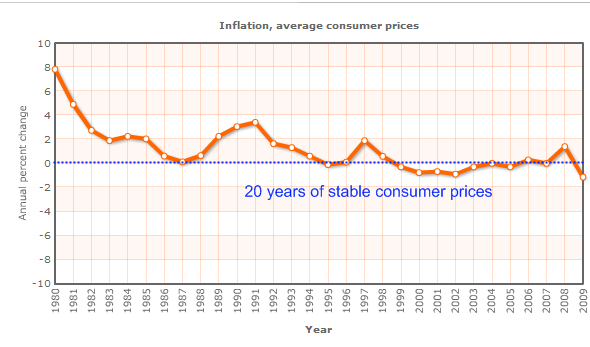
This is an interesting pattern that is playing out here in the U.S. The crushing blow to housing has kept a lid on inflation as the economy contracts. The size of the bubble has kept inflation muted at least by how it is measured by the CPI. We’ve argued that the BLS does a very poor job at measuring the cost of housing by using an owner’s equivalent of rent but that is the system that is in place. As measured by both charts above, the bursting of the real estate market allowed each country’s central bank to save the banking system without causing dramatic inflation in the economy. Sure food, education, fuel, and healthcare went up in costs but who uses those things anyway? As measured by each government department, inflation has been contained in each country:
japan-inflation
Part of this also has to do with the fear running through the global markets. People want to park their money in stable countries. You don’t see a rush of people buying up Greece or Spanish debt yet people are comfortable in Japanese and American debt. This is why as the debt ceiling “solution” was largely a kick the can down the road response money rushed into the U.S. markets and pushed mortgage rates even lower. Rates are so absurdly low yet this is doing very little to save the market. Why? Well we have 46,000,000 Americans on food stamps which doesn’t exactly seem like a good sign. Many Americans are first trying to deal with the employment market before trying to purchase a home.
The rise of part-time employment is also a very common theme in both countries. In Japan nearly one-third of the work force now works part-time or on a contractual basis yet is counted as fully employed. We have that similar issue here in the U.S. as our “part-time” category has shot through the roof. Headline unemployment is 9 percent but throw in the part-time looking for full work or those who have dropped out of the labor force and we have a figure above 16 percent.
Two decades of collapse
us-japan-bubbles-sept08
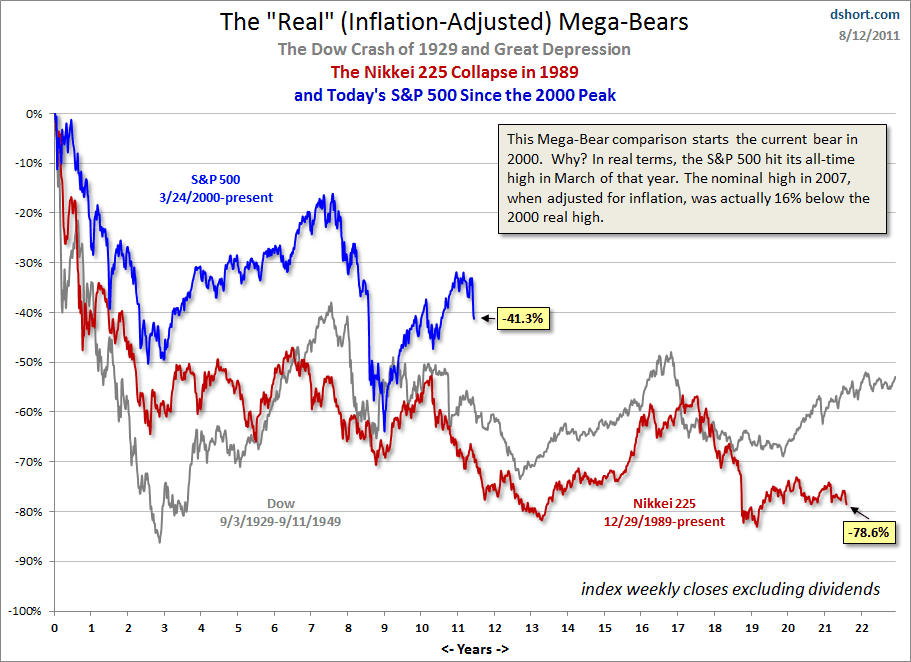
Japan is heading to a third lost decade which is hard to believe. The U.S without a doubt will have a lost decade. Even comparing stock markets we see problems ahead:
mega-bear-2000-real
Source: Dshort.com
Japan’s Nikkei 225 index is down 78 percent from the peak reached 21 years ago! Our S&P 500 index is down 41 percent from where it was in 2000. I know many people discount the similarities between the two countries but you have many comparisons and the path each country is following is very similar:
-Central banks protect banks and turn them into zombies hiding assets in balance sheets
-Incredibly low rates for decades
-Stock market bubble followed by real estate bubble
-Rise of part-time employment workforce
-Drag on GDP
-Massive fiscal deficits
-Artificially low interest rates
-Inflation controlled in government measures
-Large aging populations
-Poorer younger generation
A big difference is the demographic argument and population growth. Yet I would argue that we have a mini-Japan like issue at hand with baby boomers entering into retirement. You have a wealthier previous generation trying to sell stocks and real estate to a poorer younger generation. No doubt, there will be demand for real estate but what we are seeing is demand for affordable housing, not massive debt built mansions. This is being played out here in the U.S. as there is little sign that we have a massive growing middle class emerging that will supplant the baby boomers. And one thing that we even have worse than Japan is our massive burden of student loans on Americans. The student debt market is now larger than the credit card market here in the U.S. Japan does not have a similar massive student loan market. So that is actually a larger negative that we have that Japan doesn’t. Just because you have a growing population means nothing if you can’t bring them into the middle class. Food stamp participation has shot up 70 percent in the last four years and now one out of every six Americans is on this program. Yet what isn’t brought up is that these were folks once not on food stamps. So we are pulling people from the middle class or the working poor deeper into the inequality and this is causing our system to stall and enforces government policy that simply protects the too big to fail banking sector.
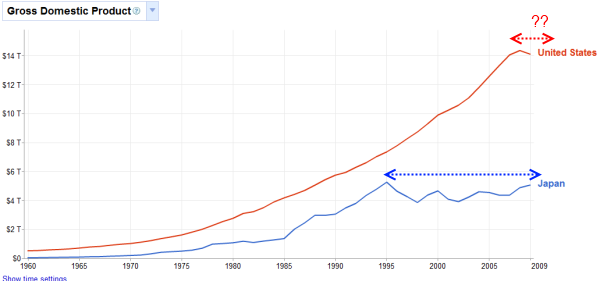
So far we’ve been in this crisis for four solid years and the path seems extremely similar with differences here and there. Japan’s multiple lost decades have hurt its overall economy:
gdp us and japan
Japan’s GDP growth has stalled since 1995. For the first time since the 1950s has the U.S. had a stall in GPD growth dragging out for four years. How much longer can this go? What similarities or differences do you see between the paths we are following?

Funds Slash Commodity Bets by Most in 18 Months on Economic-Growth Concern

H.K. Apartment Sellers Cut Asking Prices

http://www.bloomberg.com/news/2011-08-14/h-k-apartment-sellers-cut-asking-prices-as-surge-ends.html?cmpid=

Derek Ma and his family in May sold two of their eight properties in Hong Kong, doubling their money in four years. They’re struggling to sell the other six.

Traders Slash Bets Against Dollar by Record Amount as U.S. Treasuries Soar

http://www.bloomberg.com/news/2011-08-14/traders-slash-bets-against-dollar-by-record-amount-as-u-s-treasuries-soar.html?cmpid=

Aggregate bets the greenback will weaken against the euro, the yen, the Australian, Canadian and New Zealand dollars, the pound, the Swiss franc and the Mexican peso plunged by 154,105 contracts to 153,216 in the week ended Aug. 9, the biggest drop ever in Commodity Futures Trading Commission data compiled by Bloomberg beginning in November 2003.

The data show that for the first time since January traders are betting the currency will appreciate versus the 17-nation euro on speculation Europe’s sovereign-debt crisis is spreading.

H.K. Recession Risk is Global Warning: Forecaster

Westpac’s Evans is Hero With Australia Rate Call

http://www.bloomberg.com/news/2011-08-14/westpac-s-evans-goes-from-zero-to-hero-with-australia-rate-call.html?cmpid=

 A recent trip to Europe helped convinced Evans the region’s troubles would slow Australia’s economy, which hasn’t been in a recession for two decades.

London House Prices Plunge on Financial Turmoil

Sunday, 14 August 2011

THE ON-GOING SILVER CRASH - 2011 TO 2016

SAMEER SAYS

I THINK SILVER HAS PEAKED AT $49 THIS YEAR.

WE SAW THE FIRST PART OF THE CRASH IN MAY THIS YEAR.

SILVER WENT FROPM 49 TO 33.

THEN IT ROSE FROM 33 TO 44 FROM MAY TO AUGUST

I THINK WE WILL HEAD LOWER IN SILVER TO $25 NOW.

THE FINAL BOTTOM IN SILVER SHOULD BE WHEN SILVER IS BELOW $10.

THE MOST CONSERVATIVE SILVER BOTTOM WILL BE AT $5 IN MY OPINION.

THIS WILL  BE A REAL BUY OPPORTUNITY FOR SILVER.

I THINK MOST HEDGE FUNDS HAVE GOT IT WRONG ON SILVER - WHEN THEY SAID SILVER IS HEADING TO $100 IN APRIL - SILVER CRASHED FROM 49 TO 33 IE 35% CRASH

I M VERY SURE THAT SILVER WILL DROP LIKE A STONE.

Has Gold Peaked?

SAMEER SAYS

WE SAW THE DSI FOR GOLD AT 98% LAST WEEK WHEN GOLD TOUCHED $1800+

AS PER EWI - 5 WAVES ARE UP WITH A MAJOR PEAK IN DSI AT 98

DOES THIS MEAN WE HAVE SEEN A PEAK IN GOLD PRICES IN DOLLARS?

LET US KEEP AN EYE.

BTW GOLD IN EUROS MAY SEE SOME SIDEWAYS TRADING BUT ONE LAST PEAK STILL REMAINS TO BE SEEN -

IE IT ALSO MEANS EURO SHOULD BE WEAKER VS USD IN COMING MONTHS

100pc mortgages return to the market

http://www.telegraph.co.uk/finance/personalfinance/borrowing/mortgages/8694426/100pc-mortgages-return-to-the-market.html

Northern Bank, which operates in Northern Ireland, is offering the loans subject to affordability, although borrowers do not have to belong to a special group, such as professionals who can expect to earn high salaries in future, in order to be considered.

The bank does not offer mortgages in other parts of the UK.
Previously, buyers without a deposit normally had to rely on help from parents via a guarantee.
With “guarantor” mortgages, the home loan is effectively underwritten by the parents. So if you fell behind with monthly payments, this means that they would be obliged to pay.
The advantage of such schemes is that parents don’t have to stump up cash sums upfront and it can enable you to borrow more. But if you run into financial problems, this can affect your parents’ ability to get credit and potentially put their home at risk. Your parents would need to have sufficient income and/or equity in their home to be an effective guarantor, so not all first-time buyers would be able to obtain one of these mortgages.

Desperate Measures - SWISS FRANC

http://brucekrasting.blogspot.com/2011/08/desperate-measures.html

After Bernanke capitulated on the Fed’s responsibility to balance it’s dual mandate and committed to keep ZIRP alive for another 24 months the Swiss Franc exploded in value. It was up 6% in just a few hours. That was the biggest one-day move in 30 years.

The Swiss National Bank is getting desperate. They responded by announcing new emergency measures. They are immediately increasing “sight deposits” by CHF 40B. This is the second increase in a week. The two actions together will increase liquidity in the banking system from CHF 30B to CHF 120b. A 400% increase.

We are confronted with huge numbers every day. What does an increase of CHF 90b really mean? It’s a very big deal. Swiss GDP is about CHF 500b. So the increase in liquidity is equal to 20% of GDP. Now think of US GDP at $15 Trillion. What the Swiss have done in just a week is equivalent to $3 trillion in a big economy like the USA. That is massive.

This is the language from the SNB yesterday:

The massive overvaluation of the Swiss franc poses a threat to the development of the economy in Switzerland and has further increased the downside risks to price stability.

This was the sentence that caught my eye:

To accelerate the increase in Swiss franc liquidity, the SNB will additionally conduct foreign exchange swap transactions. The foreign exchange swap is a monetary policy instrument which the SNB uses to create Swiss franc liquidity.

From this I conclude that not only is the SNB trying to push interest rates to zero, they intend to push the interbank swap rates for Swiss Francs to BELOW ZERO. This is a form of intervention that is intended to discourage speculative holders of SFR. This action by the SNB is working as of this morning. The CHF has backed off against all currency pairs.

One sees the evidence of the monetary intervention in the short date swaps. This morning the Spot Next and Spot a Week roll of CHF to dollars is being priced in the hole. This is the area of the market where speculative holdings of CHF are rolled over. The one week bid offer spread pricing this AM is:

-1.9 / -0.83

Note that both sides of the swap are negative. This implies that CHF interest rates are negative. The left side (the bid side) is the price one has to pay if they were long CHF versus dollars and wanted to hold onto a long position for a week. Some math:

The USDCHF spot rate is .7378. The cost of the one-week roll is .00018. The cost of rolling a long CHF position of 10,000,000 Francs comes to $3,307 per week. That may not seem like a big deal as the dollar equivalent of CHF 10mm is $13,550,000. But that is not how things work in this big casino.

Currency trading is done on very high margin. Many participants can play at the table with only 2% margin. Others have to come up with as much as 5%. What does $3,307 come to when the equity involved is only a fraction of the principal? For the 5% player it comes an annualized cost of holding the position of 23% of equity. For that big shot who plays with only 2% down the rollover cost comes to an annualized penalty of a whopping 63%.

From long experience in this business I can tell you that short-term currency traders HATE negative carry trades.

 A long CHF position now has a big cost to it.

If a trader has a short Dollar/Swiss position of $100mm (a modest currency position for these folks) the cost of holding it is now $25,000 a week. This cost was zero two weeks ago. This squeeze on short date swaps is a very good reason to cut those short dollar positions. That is exactly what has happened so far today. The CHF has backed off (a bit) against all other currency pairs as of this morning. As of today, the SNB has achieved its objective of getting people out of the currency market.


This won’t last for long. There will be another tremble in the market that gets people scrambling for safety. The “go to” trade will still be to buy CHF when that happens. The cost of ownership be damned. What will happen as a result of the liquidity steps is that greater volatility in spot Swissie will occur.

The relative rate of the CHF versus Euros or Dollars is important to the SNB. But even more important is the rate of change. The short date squeeze by the SNB may result in a bit of retrenchment for a few days. But it will almost certainly result in increased volatility.

My take on the actions by the SNB is that they are trying to buy time and create a more orderly adjustment to a stronger CHF. I think the consequences will be that we will have violent intraday adjustments, but over the course of a month the Franc will be stronger anyway. The SNB is trying to buy time as measured in days. To me, that is no plan at all, just a desperate act by a desperate central bank.

How long is the list of Central Banks that are undertaking extreme measures to influence very short-term outcomes? The list is endless. Virtually every CB in the world is doing it today. As a result, extremely high volatility across all markets will prevail. Squeezing short dates often has a negative affect. Something always blows up as a result. Yet every central bank is attempting essentially the same thing. They are trying to buy time. They are the source of the volatility we are living through.

Most Americans don't have $1,000 saved for emergency

http://www.chicagotribune.com/business/breaking/chi-most-americans-dont-have-1000-saved-for-emergency-20110810,0,5900830.story

A majority, or 64 percent, of Americans don't have enough cash on hand to handle a $1,000 emergency expense, according to a survey by the National Foundation for Credit Counseling, or NFCC, released on Wednesday.

Swiss Central Bank Ponders "Temporary" Peg to Euro; Franc Trades Sharply Lower; This a Bluff? What Does it Take to Maintain a Peg? "Temporary" Defined

http://globaleconomicanalysis.blogspot.com/2011/08/swiss-central-bank-ponders-temporary.html

Back to the Swiss Franc: A currency peg is much riskier, because the defense is not in relation to its own currency as it is with interest rates. Moreover, one might expect wild swings and an immediate snap-back once the peg is removed. Thus "temporary" might mean for as long as the Euro crisis continues, and that might be a very long "temporary".

Finally, note the relative size of Switzerland vs. all the Eurozone countries. Buying "unlimited" Euros could rapidly get out of hand.

China goes through the same setup to maintain its "widening" peg to the US dollar. However, China does not allow much external trade of the Yuan.

The above discussion does not answer the bluff question, but it does state what the parameters of the defense must be. All things considered, I do believe it is a bluff.

Yes Virginia, U.S. Back in Deflation; Inflation Scare Ends; Hyperinflationists Wrong Twice Over

http://globaleconomicanalysis.blogspot.com/2011/08/yes-virginia-us-back-in-deflation.html

Hyperinflationits have now blown it twice. First, they insisted hyperinflation would happen before deflation. They were wrong. Then, during the QE2 inspired equities and commodities ramp, they said the same thing. They were wrong again.

Prior to the Great Financial Crisis I had a bet with "Heli-Ben", a staunch hyperinflationist who insisted we would hyperinflation before deflation. I won the bet but have not yet received my prize, a "crying towel" from "Heli-Ben".

By any rational measure, and certainly by my definition, the US went into a period of deflation lasting at least a year. Deflation ended in March of 2009.
In the wake of QE II hyperinflationists again started preaching about hyperinflationary crashes. Once again, and with increasing intensity, we heard things like ...

  • The US is Zimbabwe
  • No food available at any price
  • Oil is going to $200, then $400
  • Excess reserves will pour into the economy causing massive inflation
  • No one will be willing to hold US dollars
  • Treasury rates are going to the moon
  • The US dollar is going to zero

I could assign names to the above list, but I won't.

Two well-known hyperinflationists confidently predicted hyperinflation would start this year. A third said 2011 or 2012 giving himself extra time to be proven wrong.

My position all along was that the US would go in and out of deflation over a period of years, just like Japan.
I am claiming my "crying towel" prize for the second time. The US is now undeniably back in deflation. If "Heli-Ben" does not submit a "crying towel" his word is as good as his economic theories, which is to say worthless.

Definition of Terms

Before discussing terms one must define them. I have on numerous occasions defined mine, and my definition was the basis for the bet.

Inflation

Inflation is a net increase in money supply and credit, with credit marked-to-market.

Deflation

Deflation is a net decrease in money supply and credit, with credit marked-to-market.

Hyperinflation

Complete loss of faith in currency.

The first two definitions have nothing to do with prices per se, the third does (by implication of currency becoming worthless).

Price Myopia

Many if not most economists, especially Keynesians, think of inflation in terms of prices.

In contrast, Austrian-minded economists generally have definitions similar to mine except most of them fail to properly include credit in their analysis. Austrians in general look at money supply alone, and that is a huge mistake.

Role of Credit in Inflation

Failure to include credit in the definition of inflation and the analysis of economic activity causes many problems. Credit influences consumer prices, jobs creation, and asset prices. The mark-to-market value of credit influences the ability and willingness of banks to lend.
People tell me all the time, "all I care about is prices". If they really mean it, they are fools. Without credit expansion there is little hiring. Without hiring and money to pay for things, consumers cannot pay back loans and asset prices in general, crash.

Trillions of dollars in debt-inflated (thus imaginary) wealth have been wiped out in housing and the stock market because of falling credit, loss of jobs, and inability to service debt. Many homes fell in price from $500,000 to $200,000 (or equivalent percentages).

This is far more important than the price of gasoline hitting $4 or the price of carrots rising 50% to $2 a bunch. Yet, inflationists constantly fret about prices, ignoring far more important credit conditions.

Price myopia has other problems. Both Greenspan and Bernanke ignored an explosion of credit that fueled housing. Thus, a focus on prices induced errors on the way up and on the way down.

Fed Ignorance

The massive bubbles in credit and housing, were a direct consequence of Fed ignorance. Bernanke failed to see a recession and a housing bubble that would have been obvious to anyone using a proper definition of inflation.

I cannot tell someone what their definition should be, I can only point out the complete foolishness of concern over prices vs. rapid expansion or contraction of credit and credit marked-to market.

===

When I wrote "Humpty Dumpty on Inflation", the U.S. was unquestionably in a period of deflation. However, I also clearly pointed out "Every deflationist on the planet understands inflation will be back at some point and the Fed will attempt to do everything it can to avoid it."

In retrospect, the word "every" in the above sentence is too strong.

Regardless, I explicitly pointed out deflation was not permanent while also stating on numerous occasions that the US would be back in deflation, and indeed we are.

In "Humpty Dumpty" I listed conditions (symptoms) one would expect to see in deflation, as follows.

Symptoms of Deflation

  1. Falling Credit Marked-to-Market
  2. Falling Treasury Yields
  3. Falling Home Prices
  4. Rising Corporate Bond Yields
  5. Rising Dollar
  6. Falling Commodity Prices
  7. Falling Consumer Prices
  8. Rising Unemployment
  9. Negative GDP
  10. Falling Stock Market
  11. Spiking Base Money Supply
  12. Banks Hoarding Cash
  13. Rising Savings Rate
  14. Purchasing Power of Gold Rises
  15. Rising Number of Bank Failures

Scorecard
When you go to a doctor for diagnosis of an illness, the first thing the doctor inquires about is symptoms. So let's do just that for the second time.

Let's take those 15 conditions one would expect to see in deflation and see how many apply.

1- Falling Credit Marked-to-Market

The mark-to-market value of credit on the balance sheets of banks and financial institutions is the hardest of the 15 items to measure. Indeed, the mark-to-market value of credit cannot be directly measured at all.

The reason is banks do not mark-to-market assets unless those assets are worth more than they paid for them. The Fed, FDIC, and FASB (Financial Accounting Standards Board) lets banks get away with just that. Mark-to-Market rule enforcement has been postponed twice. Moreover, banks hide non-performing loans off the balance sheet in SIVs and by other tactics.

However, one can easily impute the direction of of the value of credit on the balance sheets of banks and financial institutions by watching prices of bank shares.

In 2008 shares of financial corporations plunged. In March 2009, financial assets valuations soared. That action kept up for longer than I expected.

However, early this year, bank stocks started showing weakness (long before the rest of the market), then crashed in the last couple weeks.

====

12 - Banks Hoarding Cash

I wrote about banks hoarding cash and paying negative interest rates on deposits on August 4, 2011 in Bank of New York Mellon to Slap Fees on Big Deposits Following "Global Dash For Cash"; When was Hyperinflation Supposed to Start?

Excess reserves is another measure of willingness to lend.
Excess Reserves


Excess Reserve Money-Multiplier Theory is Fatally Flawed

Some have written these "excess reserves" are waiting in the wings to cause massive inflation.

It did not happen nor will it. Simply put, the excess-reserve money-multiplier theory is potty.

Banks do not lend just because they have reserves. Indeed reserves do not enter the equation at all. Rather, banks lend as long as they are not capital impaired and as long as they have good credit risks willing to borrow.

In this case, banks are capital impaired, and there are too few credit-worthy clients who want to borrow. The result is banks do not lend and money sits as excess reserves.

Numerous Spanish Towns Face Bankruptcy

http://globaleconomicanalysis.blogspot.com/2011/08/numerous-spanish-towns-face-bankruptcy_13.html

The Spanish economic implosion continues. Various austerity measure in Europe and rate hikes by ECB president Jean-Claude Trichet will make matters worse. Some town mayors readily admit bankruptcy. Others will follow.

Border Attacks: Spanish Farmers Threaten to Block Border with France; Global Trade Wars Yet Another Sign of Deflation

http://globaleconomicanalysis.blogspot.com/2011/08/border-attacks-spanish-farmers-threaten_13.html

Hallmarks of Deflationary Times

Trade wars are hallmarks of deflationary times. Disputes between farmers in Spain and farmers in France are a case in point. When there are ample jobs, everyone is happy. When not, people blame their neighbors.

Bear in mind more austerity is coming to Spain, France, Italy, and Greece. A massive European recession is on the way, complete with rising unemployment and civil unrest, and ECB president Jean-Claude Trichet wants to hike rates. It is economic madness.

To be fair, the market should set interest rates not Central Banks.

Where would the market set rates for Europe?

I do not know, nor does anyone else, especially central bankers. However, I do know "one size does not fit all" when it comes to interest rates when countries have widely varying fiscal conditions and problems.

As one of the founding fathers of the Euro, Trichet is in a mess of his own making.

Spain Cannot Pay €26 Billion Defense Budget, Effectively Issues IOUs to Keep Within Stated Austerity Measures

Societe Generale Investor Groupama Says It Didn’t Sell a ‘Single’ Share

http://www.bloomberg.com/news/2011-08-12/groupama-says-it-didn-t-sell-a-single-societe-generale-share-during-rout.html

Groupama SA, Societe Generale (GLE) SA’s second-biggest investor, didn’t sell “a single share” in the bank in the past six weeks even as the stock plunged and analysts questioned the insurer’s financial strength.

“It’s clear the eurozone crisis makes some pressure on our solvency but I want to underline that we don’t want to join the collective panic,” Collin said Aug. 4. “We don’t see any default of Spain and Italy.”

Market-Wary Investors Seek Ways to Insure Millions in Cash

Aug. 12 (Bloomberg) -- U.S. investors seeking safety in cash amid the market turmoil can take advantage of several methods to insure millions above the Federal Deposit Insurance Corp.’s $250,000 limit.         

U.K. House Prices Slip 0.1% to 19-Month Low, Acadametrics Says


      Aug. 12 (Bloomberg) -- U.K. house prices fell to the lowest level in more than 1 1/2 years last month as banks’ requests for larger deposits deterred first-time buyers, Acadametrics Ltd. and LSL Property Services Plc said. 
       
 The average price of a home in England and Wales fell 0.1 percent from June to 217,300 pounds ($351,700), the lowest since December 2009, the groups estimated in an e-mailed report in London today. Prices dropped 2.6 percent from a year earlier. 
       
 The housing market may struggle to gain momentum as banks restrict lending and inflation outpaces growth in wages. The escalation of Europe’s sovereign-debt crisis and the downgrade of the U.S. credit rating, which have sparked a global selloff in financial markets this month, also threatens activity, Acadametrics Chairman Peter Williams said. 
       
 “There is little to suggest the market will change greatly in the next few months,” Williams said in the report. “Recent events continue to erode both confidence and the prospects for growth in house prices or indeed for the wider economy.”    
    
 Out of the 10 regions in England and Wales tracked by Acadametrics, all apart from London posted price declines in the past three months compared with a year earlier. Prices in northwest England led the drop, with a fall of 5 percent, while London posted a 0.4 percent gain.    
    
 While Acadametrics and LSL estimate that transactions in July rose 5 percent to 60,000 from June, that is still only about 58 percent of the long-term average, they said. 
       
 The Bank of England kept its key interest rate at a record low of 0.5 percent last week to boost the faltering recovery.         

 “The costs of mortgages have recently fallen and loans have become more readily available, with a strong suggestion that the core problem at present in the housing market is a lack of demand,” Williams said. “Were the economic news to improve and were the rate of price falls to continue to slow over the next few months, activity could pick up.”    
    
 Acadametrics and LSL combine initial transaction data from the U.K. Land Registry and results from other price measures for an estimate for the most recent month.